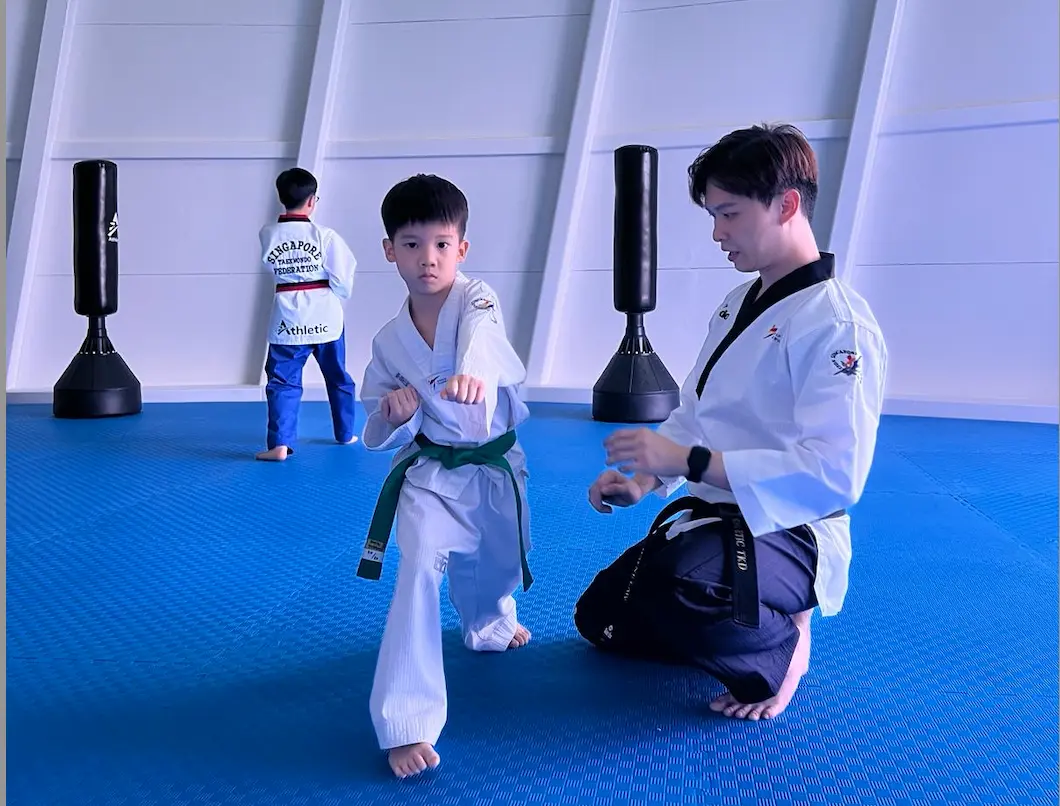
Taekwondo Belts: Order, Colours & Meaning
A complete guide to the taekwondo belt ranking system, from white belt to black belt and beyond.
A complete guide to the taekwondo belt ranking system, from white belt to black belt and beyond.

The taekwondo belt system (also written as TKD belt system) tracks a student's progress from beginner to master. Each colour marks a stage of growth in skill, knowledge and character — and every belt is earned at a grading examination, never handed out for attendance.
In World Taekwondo (WT) style — the style practised at Athletic United Taekwondo — there are 10 colour belt levels (called geup or kup) before black belt (dan). The order is the same wherever in the world you train, and the path is identical for kids and adults.
Advancing a rank is not about physical ability alone. At each grading, students must demonstrate:
Below is the standard World Taekwondo (WT) belt ranking system from beginner to the highest level. The coloured belt ranks are counted in reverse (10th geup is the lowest, 1st geup is the highest), while black belt ranks (dan) count upward.
Meaning: Purity and innocence. The student is a blank slate, beginning their taekwondo journey with no prior knowledge.
Every taekwondo student starts here. At this stage, you learn basic stances, blocks, punches and kicks. There is no grading required to receive a white belt — it is given when you first enrol.
Meaning: The earth, from which a plant sprouts and takes root. The student is laying the foundation of taekwondo.
Students begin to develop basic techniques with more confidence. You will learn your first poomsae (Taegeuk Il Jang) and demonstrate improved coordination and focus.
Meaning: The plant is growing. The student's skills are developing and beginning to mature.
At green belt, students show noticeably improved power and control. Techniques become sharper, and students learn more complex poomsae (Taegeuk Sam Jang) and combination kicks. Sparring fundamentals are introduced.
Meaning: The sky, towards which the plant grows as it matures. The student looks upward and aims higher.
Blue belt is an intermediate-advanced level. Students demonstrate strong technical ability, learn advanced poomsae (Taegeuk Oh Jang), and begin to develop their own sparring style. Board breaking techniques are refined.
Meaning: Danger and warning. The student has significant skill and must exercise caution and control.
Red belt is the highest colour belt in taekwondo. After red belt, students progress to the red-black stripe (1st geup) before testing for black belt. Students at this level are expected to demonstrate near-expert level technique, advanced poomsae (Taegeuk Chil Jang), powerful sparring and strong mental discipline. Red belts often assist in teaching junior students.
Meaning: Maturity and mastery. The opposite of white, signifying the student has overcome the darkness of inexperience.
Achieving a black belt is a major milestone, but it is really the beginning of a deeper journey. There are 10 dan levels in taekwondo, with the highest belt being 10th Dan (Grand Master) — though very few practitioners ever reach this rank. Black belt certifications are issued by Kukkiwon (the World Taekwondo Headquarters in Seoul). Students under 15 years old receive a poom belt (junior black belt) instead. The black belt (1st Dan) test requires Taegeuk 8 as compulsory, with Taegeuk 5–7 randomly selected during the exam, alongside proper kicking techniques and 3 rounds of sparring. At Athletic United Taekwondo, our instructors hold Kukkiwon-certified dan ranks, with Master Yu holding a 5th Dan.
Note: Most schools, including Athletic United Taekwondo, also have half-rank (stripe) belts between the main colours — such as white-yellow stripe (9th geup), yellow-green stripe (7th geup), and so on. The stripes on taekwondo belts signify that a student is at an intermediate level between two main belt colours. These half-rank belts help students progress in smaller, achievable steps and maintain motivation throughout their training.
Ready to start your belt journey?
Book a Free Trial ClassHere is the full breakdown of all taekwondo belt ranks, including tip (half-rank) belts, along with the typical poomsae required at each level.
| Rank | Belt Colour | Poomsae |
|---|---|---|
| 10th Geup | White | Introductory Poomsae |
| 9th Geup | Yellow Tip | Preliminary Poomsae |
| 8th Geup | Yellow | Taegeuk Il Jang |
| 7th Geup | Green Tip | Taegeuk Ee Jang |
| 6th Geup | Green | Taegeuk Sam Jang |
| 5th Geup | Blue Tip | Taegeuk Sa Jang |
| 4th Geup | Blue | Taegeuk Oh Jang |
| 3rd Geup | Red Tip | Taegeuk Yuk Jang |
| 2nd Geup | Red | Taegeuk Chil Jang |
| 1st Geup | Black Tip | Taegeuk Pal Jang |
| 1st Dan | Black Belt | Koryo |
| 2nd Dan | Black Belt | Keumgang |
| 3rd Dan | Black Belt | Taebaek |
Children aged 6 and below begin with the Taekwondo Foundation Levels — Foundation 1, Foundation 2 and Foundation 3 — before progressing to 10th Gup (White Belt). These three introductory stages build coordination, listening skills and fundamental movements at an age-appropriate pace, giving young students a clear, motivating path before they enter the formal belt ranking system.



Each taekwondo belt colour carries symbolic meaning that mirrors the growth of a plant — from seed to full maturity. This philosophy connects a student's physical training to their personal development.
To move from one belt to the next, students must pass a formal grading examination. In Singapore, gradings are conducted under the standards set by the Singapore Taekwondo Federation (STF). At Athletic United Taekwondo, gradings are held regularly and assess the following areas:
A set sequence of movements performed solo. Each belt level has a specific poomsae that students must learn and perform with proper technique, power and rhythm.
Controlled sparring demonstrates a student's ability to apply techniques against a live partner. Scoring, footwork and tactical awareness are all assessed.
Board breaking tests focus, power and accuracy. Students must break boards using specific techniques assigned to their belt level.
Students are assessed on their knowledge of taekwondo terminology, the five tenets, and their attitude and behaviour during class and grading.
Yes, it is possible to fail a taekwondo grading — students who do not meet the required standard may be asked to re-test at the next grading session. To give yourself the best chance of passing, attend classes regularly (at least twice a week), practise your poomsae at home, arrive early on grading day, and show strong spirit and effort throughout the test. Your instructors will let you know when you are ready to grade.
Want to know when our next grading is?
Ask About GradingsOn average, it takes 3 to 5 years of consistent training to achieve a 1st Dan black belt in taekwondo. However, the exact timeline depends on several factors:
At Athletic United Taekwondo, we do not rush students through the belt system. Each promotion is earned through genuine skill development and character growth.
For parents of primary school children, this dated record of belt progression matters beyond the dojang — it sits at the centre of a taekwondo DSA portfolio for Direct School Admission to secondary school.
While both taekwondo and karate use a coloured belt system, there are key differences:
| Feature | Taekwondo (WT) | Karate |
|---|---|---|
| Colour belt ranks | 10 geup levels | 6–10 kyu levels (varies) |
| Typical colours | White, Yellow, Green, Blue, Red, Black | White, Yellow, Orange, Green, Blue, Brown, Black |
| Junior black belt | Poom belt (under 15) | Varies by organisation |
| Black belt levels | 1st–10th Dan | 1st–10th Dan |
| Governing body | Kukkiwon / World Taekwondo | WKF and various organisations |
The biggest difference is that taekwondo belt colours follow a specific philosophical meaning (the growth of a plant), while karate belt colours can vary significantly between styles and schools.
Tying your taekwondo belt correctly is one of the first things you will learn. Here is the standard method:
Your instructor will help you learn this during your first few classes. It becomes second nature quickly. For younger children, parents can help by practising the belt-tying steps together at home before class — it is a great bonding activity and builds independence over time. Make sure you wear your belt over your taekwondo uniform (dobok) properly — the belt sits at the waist and holds the jacket closed.
In the World Taekwondo (WT) system, there are 10 colour belt ranks (geup) from white to red-black stripe, plus 10 black belt ranks (dan). Including stripe belts, most schools have around 10 colour belt levels before black belt.
Students start at white belt (10th geup) and progress by passing formal grading examinations. Each grading tests poomsae (forms), sparring, board breaking and theory. Students must train for a minimum period between each grading, typically 3–4 months.
Most students train for 3–4 months between each belt promotion. Achieving a black belt typically takes 3–5 years of consistent training (2–3 sessions per week). Progression depends on individual effort, attendance and skill development.
Both use coloured belt systems, but the specific colours and their meanings differ. Taekwondo follows a plant-growth philosophy (white, yellow, green, blue, red, black), while karate systems vary by style. Taekwondo also has a unique junior black belt called the poom belt for students under 15.
Place the centre of the belt on your belly button, wrap both ends around your waist to the back, bring them forward, tuck the top end under both layers, and tie a flat knot. Both ends should hang evenly. Your instructor will teach you the correct method during your first classes.
Absolutely. Adults follow the same belt system as children and can start at any age. Many adults find the structured progression motivating. Check out our adult taekwondo classes to get started.
A poom belt is a junior black belt awarded to students under 15 years old. It is half red and half black, signifying that the student has achieved black belt level skill but has not yet reached the maturity required for a full dan rank. Poom holders can convert to dan when they turn 15.
At most WT-style schools, sparring is part of the grading from green belt onwards. Lower belt gradings typically focus on basic techniques and poomsae. At Athletic United Taekwondo, sparring is introduced gradually and safely with full protective equipment.
The highest belt in taekwondo is the 10th Dan black belt, also known as Grand Master rank. It is an honorary rank that very few practitioners ever achieve. Among colour belts, the highest is the red-black stripe (1st geup), which is the final rank before black belt.
Generally, no. Students must pass each grading examination in sequence and cannot skip belt levels. In rare cases, an examiner may award a double promotion to an exceptional student, but this is uncommon. The structured progression ensures that students develop proper technique and maturity at every stage.
In the standard World Taekwondo (WT) system, there is no orange belt. However, some schools that follow the ITF (International Taekwondo Federation) or ATA (American Taekwondo Association) system may include orange as an additional belt colour. If your school uses the WT system, the belt order is white, yellow, green, blue, red and black.
Not in the standard WT system. Purple and brown belts are more commonly associated with karate and some ITF taekwondo schools. In WT-style taekwondo, the main belt colours are white, yellow, green, blue, red and black.
Children follow the same belt system and grading requirements as adults. The only difference is that students under 15 years old receive a poom belt (junior black belt) instead of a full dan rank when they reach black belt level. Poom holders can convert to dan when they turn 15. See our kids taekwondo classes for more information.
Stripe belts (also called half-rank or tag belts) are intermediate ranks between the main belt colours. For example, a white-yellow stripe belt sits between white and yellow belt. The stripe indicates that the student has progressed beyond their current colour but has not yet reached the next full rank. Stripes help break the journey into smaller, motivating milestones.
Yes. If a student does not meet the required standard during a grading examination, the examiner may ask them to re-test at the next grading session. This is not something to be discouraged by — it ensures that every belt promotion is earned through genuine skill and readiness.
The black belt (1st Dan) grading requires Taegeuk 8 as compulsory, with Taegeuk 5–7 randomly selected during the exam. Candidates must also demonstrate proper kicking techniques and complete 3 rounds of sparring, focusing on control, timing, stamina, speed, and overall technical ability. A strong display of confidence, discipline, and correct taekwondo spirit is also expected throughout the assessment.
Technically you can, but many practitioners choose not to. There is a longstanding tradition that washing your belt washes away the knowledge and effort you have put into training. If your belt does need cleaning, hand wash it in cold water with mild detergent and air dry it flat — avoid the washing machine as it can damage the stitching and cause the belt to lose its shape.
There are several popular ways to display your taekwondo belts at home. Belt display racks (wall-mounted wooden or acrylic holders) are the most common option, allowing you to showcase each belt you have earned in order. Shadow boxes and display cases are another option for preserving and framing individual belts, particularly your black belt.
Whether you are a complete beginner or looking to advance your skills, our experienced instructors will guide you every step of the way. Book a free trial and take the first step towards your black belt.